


In the PCBA (Printed Circuit Board Assembly) process, the solder paste printing step arguably triggers the vast majority of soldering defects. Industry data shows that roughly 60% to 70% of soldering defects originate at the printing stage. As the most critical tool for solder paste printing, the stencil’s cleanliness directly affects solder paste release performance and print uniformity. TORTAI Technologies, a service provider deeply rooted in high-reliability PCBA for over a decade, operates a 4,600 m² state-of-the-art facility in Humen, Dongguan, equipped with four fully automated high-speed SMT lines and certified to IATF 16949. We have always made stencil cleaning a core element of process control. This article analyzes how stencil cleanliness impacts printing quality and soldering yield, examining dimensions such as eliminating solder bead formation, mitigating insufficient solder on micro-components, preventing material cross-contamination, and implementing digital standard controls.
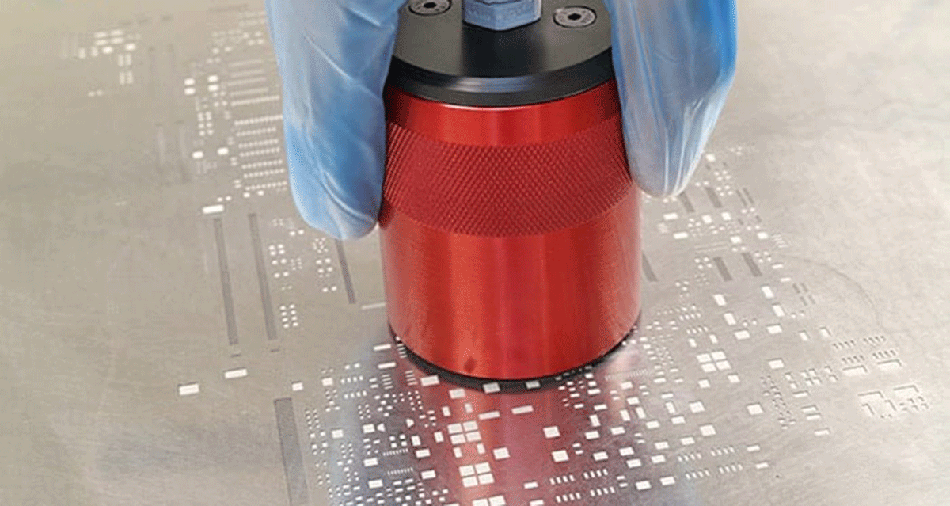
1、Core Reason: Why High-Quality Manufacturers Set Extremely High Standards for Stencil Cleaning
1.1 Eliminating Solder Bead Formation at the Source to Prevent Soldering Defects
During continuous, high-volume printing, the squeegee pressure squeezes small amounts of solder paste past the aperture edges, depositing it on the bottom side of the stencil that contacts the PCB. Without a standardized wiping and cleaning procedure, this residual paste gradually dries and hardens. When the stencil is next used for printing, these deposits lift the stencil, creating microscopic gaps between the stencil and the PCB surface. Once such a gap forms, solder paste can easily seep outside the pad boundaries. During reflow soldering, the molten paste that has bled out cannot pull back onto the pads, forming scattered solder beads on the solder mask surface.
TORTAI Technologies Control Standard:A wet wipe followed by a dry wipe is performed after printing every 5 to 10 boards, combined with periodic deep ultrasonic cleaning, to physically eradicate recurring solder bead issues. Data demonstrates that a standardized cleaning process reduces solder bead incidence by over 90%.
1.2 Mitigating Insufficient Solder and Skipped Prints on Micro-Components
As electronic products continually move toward miniaturization and higher density, precision components such as 01005 chip packages, ultra-fine-pitch BGAs, and QFNs are increasingly used, and the corresponding stencil apertures have become extremely small. During printing, solder paste release from these micro-apertures is highly susceptible to friction with the aperture walls. If the stencil is not thoroughly cleaned, dried solder powder and flux residues accumulate inside the apertures. These contaminants not only alter the effective aperture dimensions but also increase internal wall roughness. During printing, paste tends to cling to these residues, resulting in skipped prints or insufficient solder paste volume.
TORTAI Technologies Solution: Dedicated cleaning equipment is deployed, paired with compliant cleaning agents and a high-pressure spray structure, to ensure aperture walls remain clean and smooth, guaranteeing consistent solder paste volume on every micro-pad. For a 0.4 mm pitch BGA, aperture wall roughness after cleaning is controlled to Ra ≤ 0.8 µm, and solder paste transfer efficiency is stably maintained above 95%.
1.3 Preventing Material Cross-Contamination and Preventing Latent Solder Joint Quality Issues
Stencils are heavily reused and circulate constantly within the factory. When cleaning residues are not thoroughly removed, old flux residues mix with fresh solder paste, disrupting the intended flux activity ratio. Residues that linger for extended periods tend to oxidize and absorb ambient moisture. Once mixed into new paste, they degrade the solder’s wetting capability and easily create voids within the solder joints. Especially when a line switches between lead-free and leaded production, inadequate stencil residue removal can cause lead element cross-contamination, affecting product compliance.
TORTAI Technologies Control Measures:Stencils are dedicated to specific alloy systems (SAC305/SN63PB37) and stored in separate zones. A deep clean (combining ultrasonic and spray processes) is executed during production changeovers to reduce cross-contamination risk to zero. After cleaning, an ionic contamination tester verifies that residue levels remain ≤ 1.5 µg NaCl/cm².
1.4 The Fundamental Guarantee of Process Stability
Problems resulting from insufficient stencil cleaning frequency typically do not surface immediately at production start-up but gradually intensify as production time accumulates. A line may exhibit excellent print quality initially, but after dozens or hundreds of PCBs, the solder paste deposition volume on certain pads begins to vary. This change is usually not abrupt but accumulates slowly as stencil residue builds up. If a reasonable cleaning cycle is not established on the production floor, these printing fluctuations continually amplify, ultimately manifesting as an increase in soldering defects after reflow.
TORTAI Technologies Process Logic:Cleaning frequency is dynamically adjusted based on SPI (Solder Paste Inspection) data. When SPI detects that paste volume on certain pads is starting to deviate outside the normal range, executing a timely stencil cleaning restores printing stability. Through the dual strategy of “data-driven adjustments + scheduled maintenance,” the printing process Cpk is consistently maintained above 1.33.
1.5 Extending Stencil Lifespan and Reducing Consumable Costs
During continuous use, copious solder paste residues inevitably adhere to the stencil surface and inside the apertures. If these contaminants are not removed in time, they not only gradually corrode the stencil body, causing deformation, cracking, or even rendering it unusable, but also directly lead to uneven printing and aperture clogging. Industry statistics indicate that about 60% of soldering defects in SMT production originate from the printing stage, with over 30% directly linked to poor stencil condition.
TORTAI Technologies Practice:Standardized cleaning can extend stencil lifespan by 30% to 50%. A 55 × 65 cm stencil is immediately scrapped if its tension drops below 30 N/cm, and stencils are mandatorily replaced once the cumulative print count exceeds 50,000 cycles, ensuring that print quality is never affected by stencil aging.
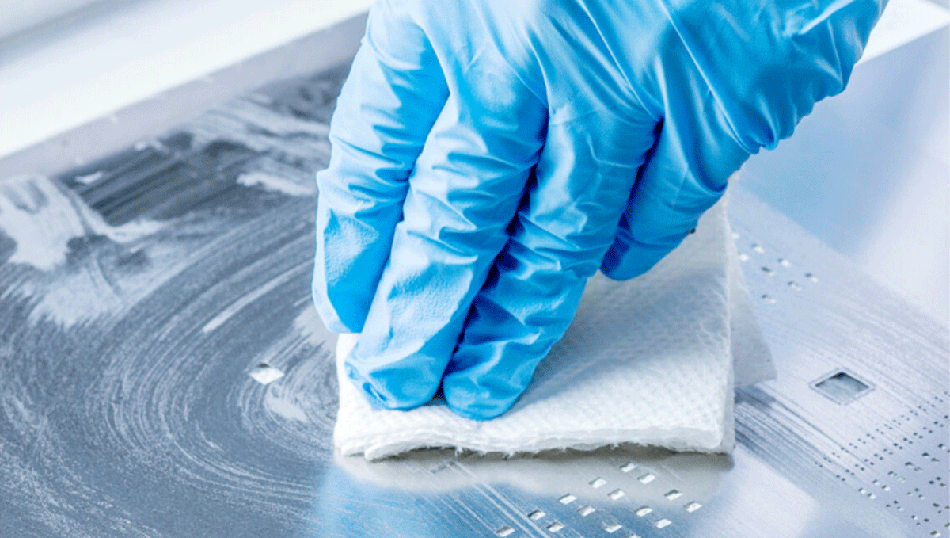
2、TORTAI Technologies Standardized Stencil Cleaning Process
2.1 Selection of Cleaning Method
The mainstream cleaning methods currently adopted by the industry include manual cleaning, ultrasonic cleaning, and spray cleaning:
- Manual Cleaning:Suitable for small-batch or fast changeover scenarios, using cleaning solvent, brushes, stencil wipes, and an air gun, but it is difficult to guarantee consistency.
- Ultrasonic Cleaning:Uses high-frequency oscillation to dislodge adherent contaminants, ideal for deep cleaning of hardened residues.
- Spray Cleaning:Utilizes compressed air as the energy source to uniformly spray cleaning solvent onto the stencil through high-pressure nozzles, balancing both efficiency and effectiveness.
- TORTAI Technologies Choice:For volume production, we standardize on fully automatic spray cleaning machines, employing a three-stage “wash-rinse-dry” process. A single cleaning cycle takes 8 to 12 minutes and achieves 100% stencil cleanliness, fully integrated with a closed-loop SPI data control system.
2.2 Cleaning Frequency Standards
TORTAI Technologies dynamically adjusts cleaning frequency based on factors including product type, solder paste type, production tact time, and ambient humidity:
- High-density PCBs (0.4 mm pitch and below):Perform bottom wiping every 3 to 5 boards.
- Standard PCBs:Perform a wet wipe followed by a dry wipe every 10 to 15 boards.
- Deep Cleaning (Ultrasonic/Spray):At least once per shift (every 8 hours), or performed at every line changeover.
2.3 Post-Cleaning Verification
- Visual Inspection:The top and bottom surfaces of the stencil must show no visible solder paste or debris.
- Aperture Wall Inspection:Use a 20× magnifier or microscope to spot-check critical apertures and confirm no residue remains.
- SPI Data Monitoring:If solder paste deposition volume deviation exceeds ±15%, trace back to the stencil cleaning step for corrective action.
- Tension Testing:Stencil tension is tested weekly to ensure a 55 × 65 cm stencil maintains tension ≥ 30 N/cm.
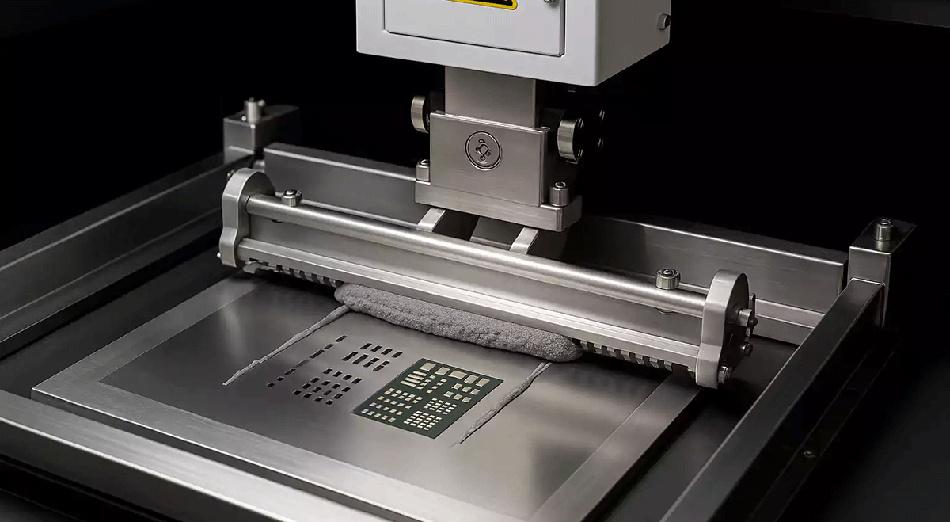
3、TORTAI Technologies Real-World Case: Ultra-Fine-Pitch BGA Server Motherboard
Project Background
- Product Type:AI server motherboard, populated with 32 pieces of 0.4 mm pitch BGA chips.
- Original Problem:SPI inspection for a certain batch detected BGA pad solder paste volume deviations reaching ±25%, resulting in a post-reflow cold joint rate of 3.2%.
- Root Cause Analysis:The stencil had been used 200 times without undergoing deep cleaning; residual dried solder powder on micro-aperture inner walls caused uneven paste release.
Corrective Actions
- Increased cleaning frequency from once every 15 boards to once every 5 boards.
- Introduced a fully automatic spray cleaning machine to replace manual wiping.
- Established an “SPI threshold alert + stencil cleaning linkage” mechanism: when SPI detects solder paste volume deviation exceeding ±10%, it automatically triggers a stencil cleaning command.
Measured Results
| Metric | Before Correction | After Correction | Improvement |
| BGA Pad Paste Volume Deviation | ±25% | ±8% | -68% |
| Cold Joint Rate | 3.2% | 0.05% | -98.4% |
| First-Pass Yield at Pilot Run | 85% | 99.2% | +14.2% |
| Stencil Service Life | 3,000 cycles | 5,000 cycles | +66.7% |
4、FAQ (10 Questions)
Q1: Is it enough for the stencil cleaning to just make the surface look clean?
A: No. “Clean surface” does not equal “clean apertures.” What truly determines print quality is the smoothness of the aperture inner walls and whether any invisible residue film remains. Relying on visual judgment alone is the industry’s most common misconception.
Q2: Which gives better results, manual or machine cleaning?
A: Manual cleaning struggles to ensure consistency, and high-pressure air guns can easily damage the delicate stencil foil, causing aperture deformation. Machine cleaning (ultrasonic/spray) delivers more uniform and thorough results and is the mainstream choice for mass production.
Q3: How should the stencil cleaning frequency be determined?
A: It should be dynamically adjusted based on factors such as PCB pad pitch, solder paste type, production tact time, and ambient humidity. High-density PCBs are recommended to be wiped every 3 to 5 boards, and standard products every 10 to 15 boards.
Q4: What cleaning agent should be used with a stencil cleaning machine?
A: Water-based cleaning agents are recommended. They are environmentally friendly, non-toxic, non-flammable, and used with DI water rinsing, posing no safety hazards or harm to personnel. The concentration and temperature of the cleaning agent need to be adjusted based on the type of residues.
Q5: Under what conditions should a stencil be scrapped?
A: A stencil should be immediately scrapped when its tension (for a 55 × 65 cm frame) drops below 30 N/cm, the cumulative print count exceeds 50,000 cycles, visible damage appears, or the PCB version is upgraded.
Q6: What are the precautions for stencil storage?
A: The storage environment must be clean and tidy. Stencils must not be stacked or have foreign objects placed on them, to prevent deformation of the foil, apertures, or frame, which would affect subsequent use.
Q7: Can inadequate stencil cleaning cause solder joint voids?
A: Yes. Residual flux residues, when mixed into fresh solder paste, degrade the solder’s wetting ability and create voids inside the solder joints, compromising joint reliability.
Q8: How should stencils be handled when switching between lead-free and leaded production?
A: A deep clean must be executed to prevent lead cross-contamination. TORTAI Technologies uses a combined ultrasonic and spray cleaning process, followed by ionic contamination testing to verify that residue levels remain ≤ 1.5 µg NaCl/cm².
Q9: How does TORTAI Technologies verify stencil cleaning effectiveness?
A: We employ a four-tier verification mechanism combining “Visual Inspection + Microscope + SPI Data + Tension Testing” to ensure every cleaned stencil meets process requirements. SPI data monitors solder paste deposition volume in real time, automatically tracing back to the cleaning step when deviations exceed thresholds.
Q10: Does stencil cleaning significantly impact PCBA processing costs?
A: What appears to be saving a few minutes of cleaning time and a few dollars in consumable costs often ends up being repaid many times over in quality degradation, batch rework, and customer complaints. Standardized cleaning is an exceptionally cost-effective investment.
5、Conclusion
Stencil cleaning is not merely superficial cleaning; it is a critical link that directly impacts print quality and process stability. From eliminating solder bead formation and mitigating insufficient solder on micro-components to preventing material cross-contamination and extending stencil service life, systematic control of stencil cleaning directly determines the overall yield and long-term reliability of PCBA processing.
In the practice of standardized stencil cleaning control, TORTAI Technologies has been deeply engaged in the high-reliability PCBA/OEM/ODM/EMS field for over a decade. We possess a 4,600 m² state-of-the-art facility, four fully automatic high-speed SMT lines, two DIP insertion lines, and ICT/FCT test lines. We hold ISO 9001:2015, ISO 13485, and IATF 16949 certifications, execute to IPC-A-610J CLASS III standards, and are equipped with an MES traceability system. Leveraging our accumulated practical experience in stencil cleaning standardization (wiping every 5–10 boards), SPI data closed-loop control (±10% deviation threshold auto-triggers cleaning), equipment automation (fully automatic spray cleaning machines), and process verification (four-tier inspection: visual, tension, ionic contamination), TORTAI Technologies can assist customers in establishing a full-lifecycle control system from “stencil incoming” to “cleaning and scrapping,” helping customers consistently maintain solder paste printing Cpk above 1.33 and reduce soldering defect rates by over 98%.